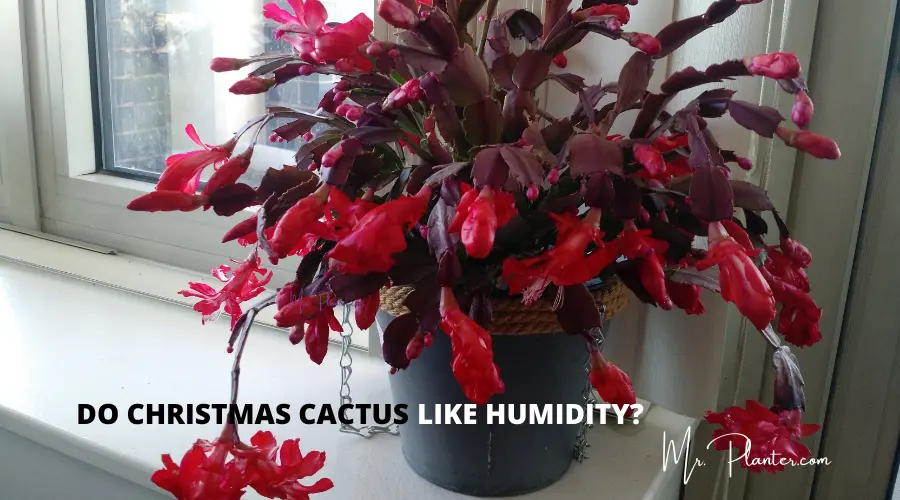
If you’re new to Christmas cactus (also called holiday cactus), one question comes up constantly: does this plant actually need humid air, or is it more forgiving like other succulents?
Short answer: Yes. Christmas cactus is a jungle cactus native to the coastal rainforests of Brazil, not a desert cactus, so it does prefer more humidity than the average houseplant. The ideal range is 40–60% relative humidity — close to what most homes already sit at, which is why it’s rarely a dealbreaker for indoor growers.
Key Takeaways
- Christmas cactus is a rainforest epiphyte, not a desert cactus — it wants moderate humidity, not dry air.
- The target range is 40–60% relative humidity, measured with a hygrometer, not guessed.
- Misting helps in short-term, low-humidity situations, but it isn’t a substitute for a genuinely humid environment and shouldn’t be your only strategy.
Why Christmas Cactus Needs Humidity
Unlike desert cacti, Christmas cactus (Schlumbergera) grows naturally on tree branches in humid, shaded rainforest canopies. That native habitat is why it behaves differently from the succulents most people group it with — it wants moisture in the air, not just in the soil.
When indoor air stays too dry for too long, you’ll typically see:
- Limp, wrinkled, or flattened segments
- Buds dropping before they open
- Slower growth overall
When humidity runs too high with poor airflow, the opposite problem shows up — fungal issues and root rot, especially if the soil is also staying wet. The goal isn’t “more humidity is better.” It’s landing in that 40–60% band and keeping air moving.
How to Check Your Room’s Actual Humidity
Don’t guess — a $10–15 digital hygrometer placed near the plant (not on a windowsill, where readings skew) gives you a real number in seconds. As a rough proxy: condensation on windows usually means humidity is running high; static shocks and dry skin usually mean it’s running low. But for anything more precise than “high or low,” a hygrometer is worth the small cost.
We suggest checking out some of the top-rated humidifiers available on Amazon, such as the:


How to Raise Humidity Around Your Christmas Cactus
If your hygrometer reads below 40%, here are the methods that actually move the needle, roughly ordered by effort:
- Pebble tray. Fill a shallow tray with pebbles or gravel, add water just below the top of the pebbles, and set the pot on top. As the water evaporates, it raises humidity right around the plant. Keep the pot’s base above the waterline — sitting in standing water causes root rot.
- Group your plants. Plants release moisture through transpiration, so clustering several together creates a small shared microclimate with noticeably higher local humidity than a single plant on its own.
- Run a small humidifier. This is the most reliable fix if your home runs dry year-round (common in winter with forced-air heating), since it controls humidity for the whole room rather than just a few inches around one pot.
- Move it out of drafts. Keep the plant away from heating vents, AC units, and drafty windows — these dry the air faster than almost anything else and can undo the other three methods.
Should You Mist Your Christmas Cactus?
This is the part where advice online tends to contradict itself, so here’s a straight answer: misting can help, but it’s a minor supplement, not a primary strategy — and it comes with a real tradeoff.
Why it can help: A light misting in the morning temporarily raises the moisture right around the foliage, which is useful if your home runs dry and you don’t want to run a humidifier constantly.
Why it’s not a full solution:
- The humidity boost from misting fades within an hour or two — it doesn’t move your baseline room humidity.
- Water sitting on the segments, combined with poor air circulation, is the most common trigger for fungal spotting on this plant.
- It does nothing for your soil moisture needs — misting is not a substitute for proper watering.
If you do mist: use lukewarm water, mist in the morning so foliage dries by evening, keep the plant away from drafts, and skip it entirely if your home is already humid or if the plant has any history of fungal spotting. For most growers, a pebble tray or humidifier is a better long-term fix than regular misting.
Signs You’ve Got the Humidity Wrong
Too dry:
- Leaf segments look thin, wrinkled, or limp
- Buds form but drop before opening
- Leaf tips turning brown and crispy
Too humid (usually paired with poor airflow or overwatering):
- Mushy, discolored segments
- Musty smell from the soil
- Visible mold on soil surface or pot rim
If you’re seeing the “too humid” signs, check your watering schedule first — overwatering combined with still air is almost always the real culprit, not ambient humidity alone.
FAQ
Q1. Is Christmas cactus a rainforest plant or a desert plant?
Rainforest. It’s an epiphyte native to Brazil’s coastal forests, which is why it behaves more like a tropical houseplant than a typical desert cactus when it comes to humidity and light.
Q2. Will low humidity kill my Christmas cactus outright?
Not usually on its own — it’s more likely to cause dropped buds, slower growth, and stress that makes the plant more vulnerable to pests, rather than sudden death.
Q3. Do I need a humidifier specifically for one plant?
Only if your home runs consistently dry (common in winter with central heating). If you’re already in the 40–60% range, a pebble tray or plant grouping is usually enough.
Q4. Is misting required for Christmas cactus to bloom?
No. Blooming is driven mainly by temperature and light cycles in fall, not misting. Misting only affects short-term humidity around the leaves.
The Bottom Line
Christmas cactus does prefer humidity in the 40–60% range, which most homes already fall within.
Rather than misting on a schedule, check your actual humidity with a hygrometer first, and reach for a pebble tray, plant grouping, or a small humidifier if you’re consistently running dry.
Misting is fine as an occasional top-up, but it’s not the fix for a genuinely dry room.
Related reading:
Christmas Cactus Humidity Needs: Complete Guide
Succulents vs Cactus: What’s the Difference?
Christmas Cactus vs Thanksgiving Cactus